

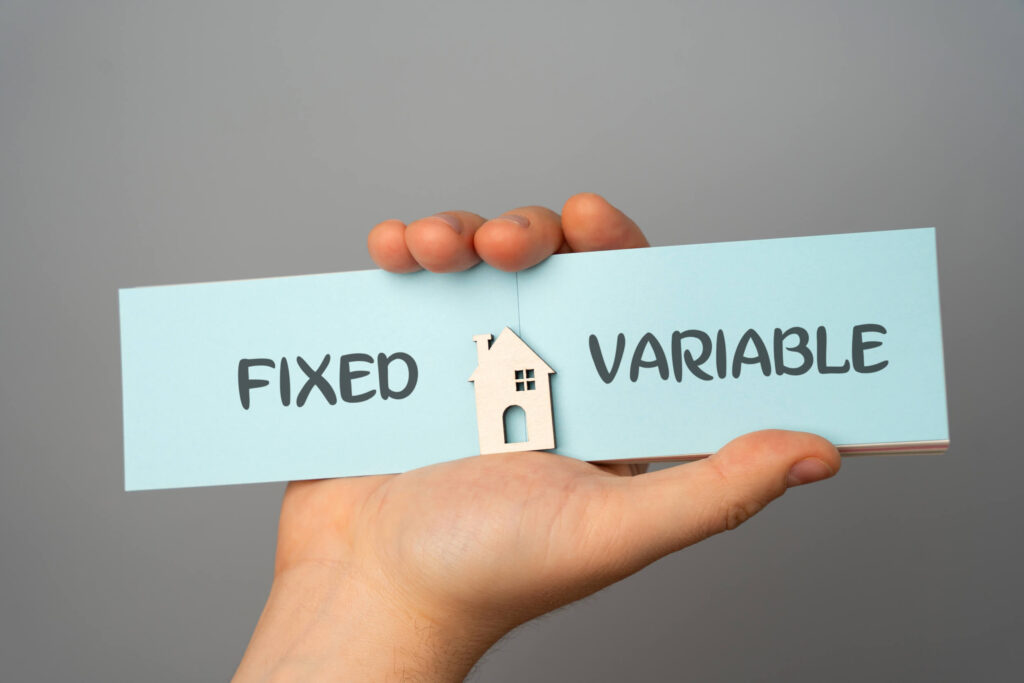
What’s the best choice for your home loan – a fixed or variable interest rate?
Variable interest rate home loans
Variable interest rates are popular because they offer flexibility and lower repayments if interest rates go down. Most of our clients opt for variable rate loans, and it’s what we recommend in most situations.
A variable interest rate loan also gives you access to an offset account, which can save you a decent amount of money over the life of your loan (more on offset accounts, below).
When you’re on a variable interest rate you can pay more money off your loan through unlimited additional repayments. For example, if you receive a pay rise or bonus, inherit some money, or sell something substantial, you could pay above your minimum repayments, save on interest over the long term, and pay off your mortgage sooner.
Fixed interest rate home loans
If you’re someone who prefers continuity, a fixed interest rate could suit you. If you prefer to err on the side of caution, a fixed rate might help you sleep at night. With a fixed rate, you’ll know exactly what your repayments will be from month-to-month. You won’t have to stress when interest rates rise. Although, at the end of your fixed rate term, your repayments will revert to the current cash rate (which may be either higher or lower!).
Something else to be aware of: banks usually factor in potential future rate rises so your fixed interest rate will likely be higher than the current standard rate. Another downside: no access to an offset account, and limits on how much extra you can pay off your loan over the fixed term.
What is an offset account and how does it work?

An offset account is a fully transactional bank account that’s linked to your home loan. The purpose of an offset account is to reduce the amount of interest you pay over the life of your home loan.
The balance in your offset account reduces the balance of your home loan for interest calculation purposes only. You still owe the full amount, and you still have access to all the money in your offset account. Interest is calculated on the balance of your home loan minus the balance of your offset account, rather than the full home loan balance.
How much money can you save with an offset account?
Here’s an example of how much money can be saved with an offset account:
Say you have a $650,000 loan and you have $75,000 in your offset account – you only pay interest on $575,000. On a home loan with a 5.50% interest rate, this could save you over $240,000 in interest, and 5.5 years off your loan.
Want how much interest you could save over the life of your loan with an offset account? Plug your details into our offset account calculator.
Is a fixed or variable interest rate better for your home loan?
Generally speaking, a variable interest rate is beneficial in the long run. Everyone’s circumstances are different though, and everyone has different motivations and goals. As your mortgage broker, we’ll work with you to find out what type of loan structure would work best.
Have any questions, or ready to get the ball rolling on a loan? Reach out today! We’re an online mortgage broker servicing Australia-wide.

