
We knew further interest rate hikes were coming, but the news still hits where it hurts. Today we’re discussing the cause, and revealing upcoming lender deadlines. We’ll explain some negative gearing options that may accompany Federal Budget announcements on Tuesday 12 May. And finally – are you due to refinance your home loan? We’ll help you understand if this is a good time.
Here’s what we’re covering today:
- The RBA’s latest interest rate announcement
- Spotlight on negative gearing and capital gains tax discount
- Myth-busting common refinancing misconceptions
What just happened with interest rates?
The Reserve Bank of Australia (RBA) Board has wrapped up its May 2026 meeting. Here’s what they’ve decided to do with interest rates:
| OLD RATE | CHANGE | NEW RATE |
| 4.10% | +0.25% | 4.35% |
The Reserve Bank of Australia lifted the cash rate by 25 basis points to 4.35% on Tuesday.
Unfortunately, but not unexpectedly, rates have now been increased 3 times in a row. The underlying reasoning behind this move is the conflict in the Middle East and the sharp price increase to fuel. Higher transport costs flow through the economy, impacting price of food, materials and retail goods – anything that needs be transported.
Increases in fuel and goods prices have raised inflation to 4.6%, which is now well above the RBA’s target range of 2% to 3%. Michele Bullock, RBA Governor, admits that there is only one tool available to the board when it comes to trying to battle inflation and that is to raise interest rates.
This latest rate increase brings rates back to where they were in early 2025 before the RBA began cutting rates.
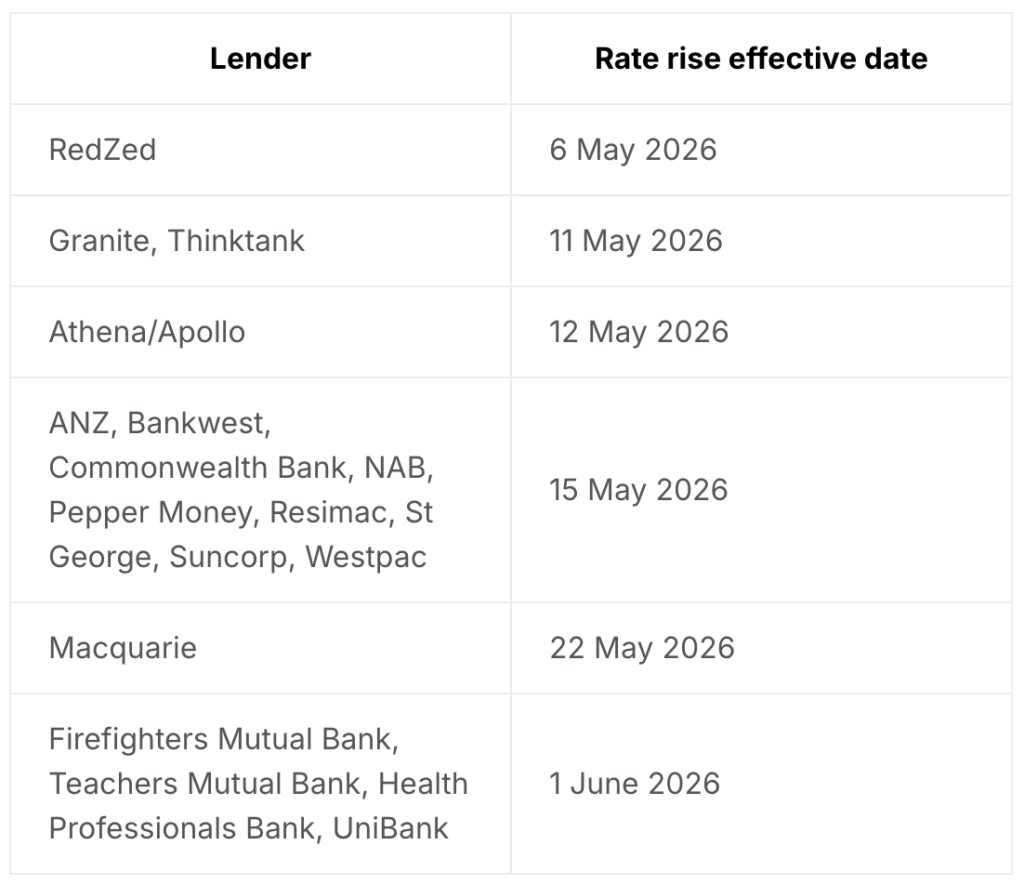
Increases to interest rates have the effect of reducing the amount you can borrow. If we’ve had a discussion recently about your borrowing capacity, this rate rise will have an impact. There is a small window between now and when banks will raise their rates. At the time of writing, the following banks have announced interest rate rises 0.25% effective from these dates:
Negative gearing and capital gains tax discounts on the horizon?
Ahead of the Federal Government Budget announcement on 12 May, negative gearing and the capital gains tax (CGT) discount are in the spotlight. Some of you might be wondering ‘WTF is negative gearing?’ and ‘WTAF is a CGT discount?’
Seen by many as a tipping of the scale in favour of the ‘haves’ at the expense of the ‘have nots’, both negative gearing and the CGT discount are only available to people who own (negative gearing) or sell (CGT discount) investment assets. These assets could include shares and bonds, but more commonly the conversation gets heated when discussing property. But why should you care?
Firstly, ‘gearing’ means to borrow money to buy an asset. Over the course of a financial year an asset will either be positively geared, neutrally geared, or negatively geared. Positively geared means that the asset generates more money than it costs to own the asset; neutrally geared means the asset generates the same amount of money it costs to hold (this would only happen very rarely in reality); and negative gearing occurs when the cost of owning an investment (like a rental property) is higher than the income it generates. In Australia, this financial loss can be used as a tax deduction to reduce the tax you pay on your other income, such as your salary.
How negative gearing works

- Rental income: You receive $25,000 a year in rent
- Expenses: Between mortgage interest, maintenance, and rates, you spend $30,000 a year
- Result: You have a $5,000 shortfall (loss)
- Tax benefit: You can deduct that $5,000 from your taxable salary. If you earn $100,000, you only pay tax as if you earned $95,000.
Investors generally use negative gearing with the expectation that the property’s value will increase over time (capital growth). The goal is for the eventual profit from selling the property to be much larger than the total losses incurred while holding it. The ‘capital gain’ from selling the property is the selling price less the cost base (e.g. purchase price, plus stamp duty and legal fees).
The CGT discount is a rule that allows you to reduce the tax you pay on the profit from selling an investment. Essentially, if you hold an investment for more than 12 months, you only pay tax on half of the profit you made. You pay tax on the remainder at your marginal tax rate.
How the capital gains tax discount works
- Profit: You sell a property and make a $100,000 profit
- Holding period: You held it for 3 years
- Discount: You apply the 50% discount, leaving $50,000
- Outcome: Only $50,000 is added to your taxable income, rather than the full $100,000.
Importantly, if the property were sold within 12 months of buying it, no discount applies, and tax is payable on the full capital gain amount.
The argument against the current rules is deeply rooted in the debate about housing affordability – whether younger Australians have a fair shot at home ownership, and whether the tax system is giving investors too much of an edge over people trying to buy a home to live in.
The reason negative gearing and CGT tend to be discussed together all comes down to an investor’s ability to deduct the full loss while a property is being held, followed by discounted tax on an eligible capital gain when it is sold.
Make sure you’re following us on instagram to receive our Federal Budget updates.
Is now a good time to refinance? Your most common refinancing questions, answered.
Why do people refinance?
Refinancing is the process of replacing an existing mortgage with a new one. By refinancing, you can lower your monthly interest rates and effectively pay off your loan sooner. Through refinancing you have the opportunity to roll multiple high interest loans (cars, credit cards, personal loans) into one lower interest loan to streamline monthly repayments and reduce overall interest.
Some customers refinance in order to access loan features including offset accounts, redraw facilities and split loans (some of the loan on a variable rate, and some of the loan on a fixed rate). Others refinance when their fixed rate term is coming to an end, or to take advantage of cashback offers or reward programs. Sometimes people refinance to access equity to put towards renovating, investing, or other major expenses.
When is the best time to refinance?
The right time to refinance depends on what’s happening in the market and your personal financial position.
Regardless, it’s recommend that you review your home loan every two to three years. Because lenders often reserve their best rates for new customers rather than loyal ones, staying with the same lender for more than three years without a review often means you’re paying a ‘loyalty premium’.
When market forecasts suggest further interest rate hikes, as is the case now, many borrowers refinance to lock in a fixed rate for repayment certainty.
Certain personal financial milestones mark an ideal time to refinance, such as if your credit score has improved, your fixed term rate is expiring, or if your home equity reaches 20%, meaning you can refinance without repaying Lenders Mortgage Insurance.
How much does it cost to refinance?
Refinancing a home loan in Australia typically costs between $500 and $2,000 for a standard variable-rate loan. However, these costs can increase significantly if you’re exiting a fixed-rate term early, or have less than 20% equity (which would mean paying LMI again).
When assessing your suitability for refinancing, we consider all factors, including the ‘break even’ rule. We look at the total costs for refinancing (discharge fees, application fees and valuation costs) and your potential monthly interest savings.
Can you get a better rate from your current bank?
Yes, and this is usually a faster and more convenient way to adjust your loan terms. Banks are often willing to offer existing customers a lower interest rate to prevent you from switching to a competitor. It’s a good idea to have us contact your bank though, because we can run the checks first to see what the competitors are doing, and negotiate on your behalf.
How long does it take to refinance?
The time it takes to refinance a home loan in Australia typically ranges from 3 to 6 weeks.
If you’d like to find out if refinancing could be a good option for you, please reach out. We’ll do the legwork for you and walk you through the options and outcomes.
Before you go – have you subscribed to the blog? We’re an Australia-wide digital mortgage broker based in Tweed Heads, specialising in refinances and equity release. Be the first to receive our newsletter after every RBA announcement. Subscribe here.